HELM
The Helm Blog
Insights on nervous system regulation, mental clarity, and the science of optimal performance.
HELM
HELM
HELM
HELM
HELM
HELM
Insights on nervous system regulation, mental clarity, and the science of optimal performance.
Helm is the #1 app to optimize your mind, breathe better, and master your focus. Combine science-backed breathwork and meditation into your daily protocol to build resilience.
Overthinking usually feels like a mind problem, but it often starts as a body state: shallow breathing, tight jaw, buzzing chest, and a nervous system stuck on high alert. Breathing exercises for overthinkers work because they change the input your brain is receiving right now, not the story your thoughts are telling. When you slow and soften the breath, you send a clear signal of safety, and your attention has something steady to land on.
This is not about forcing a blank mind. The goal is better steering, so you can notice the spiral sooner, downshift your physiology, and choose the next action with more clarity. Below you will learn why rumination accelerates, what to do in the moment, and a simple 5-minute protocol that fits real life, meetings, parenting, and bedtime.

Overthinking is often your brain trying to predict and prevent danger. The problem is that prediction burns fuel: it recruits vigilance, speeds up breathing, and narrows your focus onto threats. When your breath becomes fast or shallow, carbon dioxide levels can drop too quickly, which may intensify sensations like lightheadedness, tingling, and urgency. Those sensations then become “evidence” that something is wrong, and the loop tightens.
Slow, controlled breathing can shift this loop by influencing vagal pathways and baroreflexes involved in heart rate and stress responses. A useful overview of the mechanisms is summarized in a research review in Frontiers in Neuroscience on slow breathing and autonomic regulation: How breath-control can change your life. You are not breathing to be perfect, you are breathing to change the state that feeds the thoughts.
One more nuance: many overthinkers unconsciously over-breathe, taking slightly bigger breaths than needed. That can keep the body keyed up. Less air, more rhythm is often the fastest path to calm.
When rumination is loud, reasoning with yourself tends to backfire. You cannot “win” an argument with a nervous system that thinks it is under threat. Instead, pick a technique that is short, specific, and sensory.
A strong option is the two-part inhale with a longer exhale, often called a physiological sigh. It is quick, discreet, and helpful when you feel the mind racing. If you want the exact cadence and how to use it without overdoing it, see this guide on the physiological sigh for a 30-second reset. The win is interruption, not total calm.
If you need something even more subtle (for example during a meeting), aim for a quiet nasal inhale and a longer nasal exhale. Nasal breathing can support nitric oxide production and smoother airflow dynamics, and it tends to keep you from gasping. For a plain-language explanation of why breath control can reduce stress arousal, Harvard Health provides a helpful overview: Breath control helps quell the stress response. Small shifts done consistently beat heroic one-off sessions.
Use this when you notice repetitive thoughts, pre-sleep worry, decision paralysis, or doom scrolling that you cannot stop. Keep it gentle, especially if you are prone to panic symptoms.
This pattern works because a longer exhale tends to reduce arousal, and the bottom pause can reinforce a sense of steadiness. If counting makes you anxious, switch to a simple rule: inhale gently, exhale longer.
If you suspect you are breathing high in the chest, you will get better results by retraining mechanics first. This breakdown of diaphragmatic breathing vs chest breathing can help you feel the difference quickly. Technique matters less than comfort, but mechanics can remove friction.
Overthinkers are often high performers. That means you may treat breathing like a task to optimize, which can quietly recreate the same pressure you are trying to reduce. The habit that sticks is the one that is easy to restart.
Anchor breathwork to predictable moments. Pair it with a trigger you already have: after you sit down at your desk, after you send the last message of the day, or when you get into bed. Two minutes done daily trains your system to shift states faster.
Also, define success correctly. Success is not “no thoughts.” Success is noticing sooner, recovering faster, and shortening the loop. A practical metric is “latency”: how long it takes you to move from spiraling to functional. Breathwork is excellent at lowering that time.
Finally, give your mind a job during the practice. Overthinkers need a narrow focus that is not stimulating. Try silently tracking the exhale like a metronome, or counting only exhales from 1 to 10. If you lose track, that is not failure, it is the rep. Returning is the practice.
The most common mistake is trying to force a big inhale. Over-breathing can make you feel worse. Keep the inhale light and prioritize the exhale. Another mistake is practicing only when you are already flooded. Train when calm so the skill is available under stress.
If you have respiratory or cardiac conditions, or if you are pregnant, ask a clinician what is appropriate for you. Avoid aggressive hyperventilation-style practices if you are prone to panic, fainting, or dizziness. For general guidance on safe breathing techniques and stress, the Cleveland Clinic has a clear overview of paced breathing practices such as box breathing: Box breathing.
Consider extra support if rumination is paired with persistent insomnia, compulsions, trauma symptoms, or panic attacks. Breathwork helps regulation, but it is not a substitute for therapy. Evidence-based approaches like CBT and mindfulness-based programs can be highly effective, and the American Psychological Association offers resources for finding care: How to find a psychologist.
Overthinking is not a character flaw, it is often a nervous system strategy that has outlived its usefulness. When you work with the breath, you are changing the conditions that keep the mind stuck: arousal, vigilance, and a body that cannot settle. Start small and stay consistent: a longer exhale, a gentle pace, and a short daily practice tied to an existing routine.
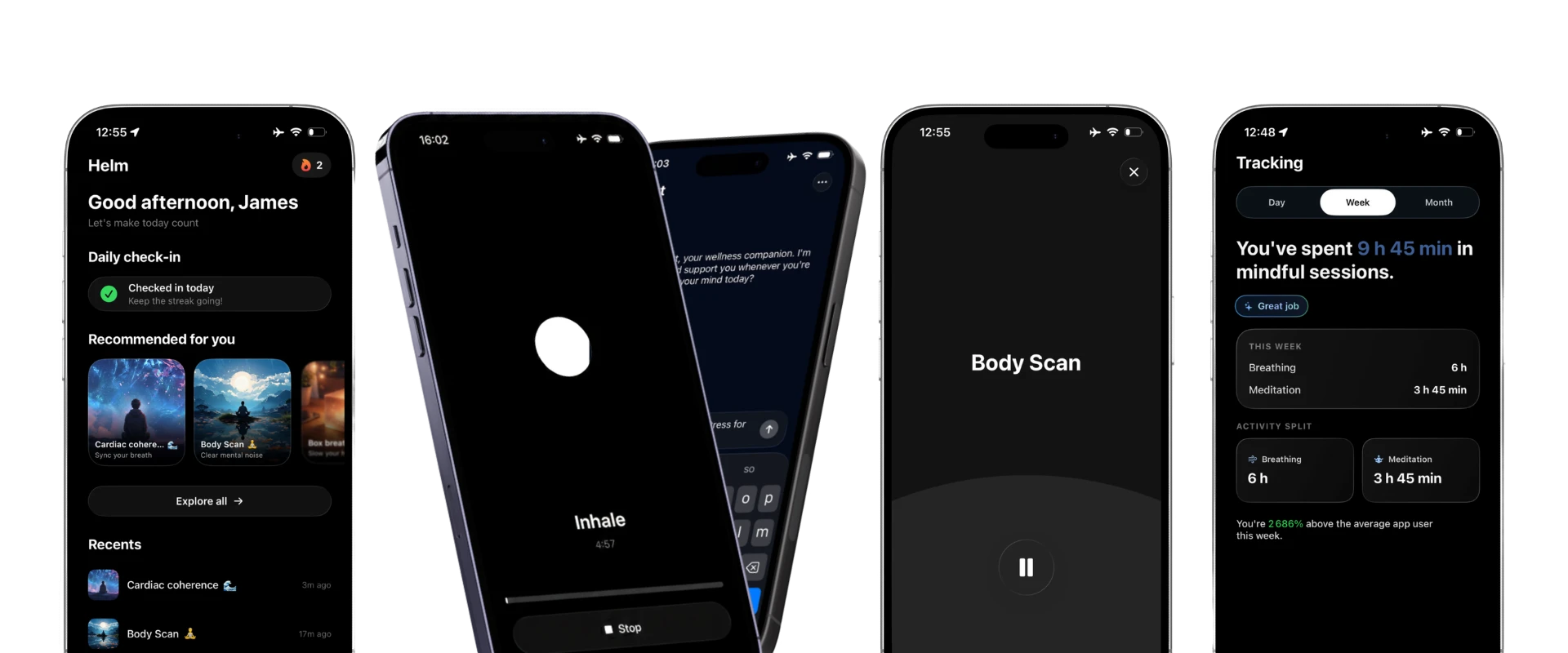
When the spiral returns, treat it like a cue, not a crisis. Interrupt the loop, downshift your physiology, then decide what actually needs attention. Over time, breathing practice becomes less of an emergency tool and more of a baseline skill for focus, sleep, and emotional clarity. If you want guided breathing resets on iOS, try Helm, a mental wellness app designed to manage stress and improve focus through short, structured sessions.
Use a gentle long-exhale pattern like 4 seconds in, 6 to 8 seconds out for 3 to 5 minutes. Keep it nasal and quiet, and avoid deep, forceful inhales that can feel activating.
They may not eliminate intrusive thoughts, but they can reduce the body alarm that makes thoughts sticky. With lower arousal, you can notice the thought, label it, and return attention more easily.
Many people feel a shift in 60 to 180 seconds, especially with longer exhales. The bigger change is long-term: daily practice improves how quickly you recover when rumination starts.
It can be, especially for focus, but some overthinkers find equal counts too “tight.” If box breathing feels stressful, switch to a longer exhale version or reduce the holds.
That is common. Keep eyes open, breathe smaller, and focus on the exhale or external sensations like feet on the floor. Start with 30 seconds and build slowly to retrain safety.
Join thousands using Helm to manage stress, improve focus, and build lasting healthy habits.