HELM
The Helm Blog
Insights on nervous system regulation, mental clarity, and the science of optimal performance.
HELM
HELM
HELM
HELM
HELM
HELM
Insights on nervous system regulation, mental clarity, and the science of optimal performance.
Helm is the #1 app to optimize your mind, breathe better, and master your focus. Combine science-backed breathwork and meditation into your daily protocol to build resilience.
If you have ever felt your mind race, your chest tighten, or your focus scatter in the middle of a normal day, you already know that stress is not just “in your head.” It is a whole-body shift toward higher arousal, faster breathing, and narrower attention. The physiological sigh for instant calm is one of the simplest ways to interrupt that loop, often within 30 to 60 seconds.
This is not a mystical technique, and it does not require a long practice session. It is a specific breathing pattern: two inhales stacked together, followed by a long exhale. The goal is to quickly downshift respiratory drive and nudge your autonomic nervous system toward a calmer baseline.
Used correctly, it can be a practical “reset button” before a difficult conversation, after a stressful email, or when you notice tension building. In the sections below, you will learn what it is, why it works, how to do it safely, and how to fit it into a broader breathwork routine.

A physiological sigh is a natural reflex your body already uses. You do it spontaneously during sleep and throughout the day, often without noticing. The pattern is distinct: a normal inhale, a second shorter inhale that “tops off” the lungs, then a long, slow exhale.
Mechanically, that second inhale can help re-expand small air sacs that may have partially collapsed, improving the efficiency of gas exchange. Subjectively, many people feel an immediate release of chest tightness because the breathing becomes more complete and less “stuck”.
From a nervous system perspective, the long exhale matters. A longer exhale tends to reduce sympathetic arousal and support parasympathetic tone, partly by shifting the balance of carbon dioxide and by engaging slower breathing rhythms that your body associates with safety.
Evidence is growing that short, structured respiration practices can measurably reduce arousal and improve mood. For example, a randomized study comparing different brief breathing patterns found that a cyclic sighing style practice improved mood and reduced physiological arousal over time (https://doi.org/10.1016/j.xcrm.2022.100895). Separately, basic physiology research highlights that sighing plays a real role in maintaining healthy breathing patterns (https://doi.org/10.1038/nature19785).
This works best when you keep it simple and physical, not performative. You are not trying to “breathe as much as possible.” You are trying to create a clean inhale pattern and a long, unhurried exhale.
Most people feel a shift after 1 round. If you are highly activated, do 2 to 3 rounds. More is not always better, and pushing can lead to lightheadedness.
Think of the physiological sigh as an acute tool for spikes, not a full nervous system program. It shines when you need to reduce activation fast and then return to the task.
It tends to help most for:
If you want something equally simple but more rhythm-based for steady focus, you might prefer boxed breathing: a 4 minute reset for calm and focus. Box-style patterns can be easier for some people because the timing is symmetrical and predictable.
If you are dealing with chronic anxiety, panic disorder, trauma-related symptoms, or frequent hyperventilation, treat this as one tool in a bigger plan. In those cases, building a base with gentle, consistent practices usually beats relying on quick fixes.
Because the pattern feels powerful, people often overdo it. The technique works through precision and slowness, not intensity.
The most common problem is inhaling too hard. Big, fast inhales can increase arousal and worsen dizziness, especially if you already tend to over-breathe when stressed. Aim for comfortable volume, not maximum volume.
Another common mistake is shortening the exhale. If the exhale becomes a quick blow-out, you lose the main downshift signal. Make the exhale longer than the combined inhales.
Finally, people sometimes “stack” too many cycles in a row. If you do 10 rounds aggressively, you can feel tingly, spaced out, or lightheaded. That is a sign you are pushing ventilation too high for your current CO2 tolerance.
Use extra care, or get clinical guidance first, if you:
In general, do this seated or standing still, never while driving, in water, or during activities where faintness would be dangerous. The goal is calm and clarity, not an altered state.
The biggest upgrade is to stop treating the physiological sigh as only an emergency move. When you practice it lightly during neutral moments, your body learns the pattern as a familiar off-ramp, so it works faster when you actually need it.
Try this once or twice a day for a week:
Pair it with a slower baseline practice if you want longer-lasting change. For example, building a small routine around breathing for anxiety relief and emotional regulation can make quick tools more effective because your overall arousal set point drops over time. A helpful next read is reduce anxiety naturally with breath: a calm, practical guide.
Also, track outcomes in the simplest way possible: notice your jaw, your shoulders, and whether your exhale naturally lengthens afterward. If you finish and immediately start breath-checking or trying to “optimize,” you may be feeding the very vigilance you are trying to reduce.
The physiological sigh is effective because it matches what your body already does to reset breathing, then amplifies the part that helps you downshift: a longer, slower exhale. Keep it gentle, do 1 to 3 rounds, and treat it as a quick bridge back to steady attention. Over time, the real win is learning to catch stress earlier, when it is still a small rise in tension rather than a full wave.
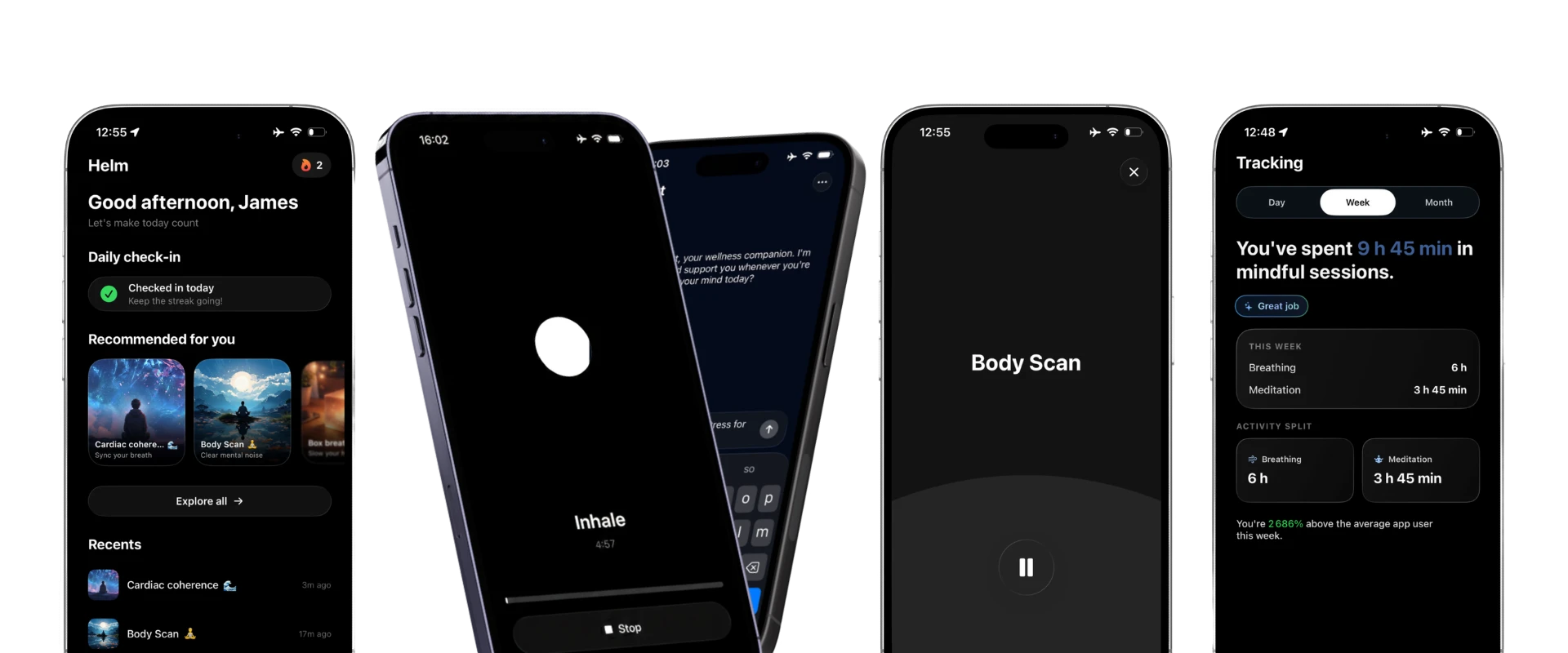
If you want guided resets on iOS, try Helm, a mental wellness app designed to manage stress and improve focus through guided breathing resets.
Most people benefit from 1 to 3 rounds. Stop once you feel a clear downshift, like a softer jaw or slower breath. Doing too many aggressively can cause lightheadedness.
It may reduce rising arousal, especially early. If panic is intense or frequent, combine it with broader support and consider working with a clinician to avoid turning breathwork into a reassurance ritual.
No. The physiological sigh is two inhales plus a long exhale, designed for rapid downshifting. Box breathing uses equal counts to stabilize attention and pacing, often better for sustained focus.
Prefer nasal inhales for smoother, slower airflow, then exhale through the mouth for a longer release. If nasal breathing is difficult, reduce volume and slow down rather than forcing.
Dizziness usually means you are breathing too big or too fast, which can lower carbon dioxide too quickly. Make the inhales smaller, lengthen the exhale, and do fewer rounds seated.
Join thousands using Helm to manage stress, improve focus, and build lasting healthy habits.