HELM
The Helm Blog
Insights on nervous system regulation, mental clarity, and the science of optimal performance.
HELM
HELM
HELM
HELM
HELM
HELM
Insights on nervous system regulation, mental clarity, and the science of optimal performance.
Helm is the #1 app to optimize your mind, breathe better, and master your focus. Combine science-backed breathwork and meditation into your daily protocol to build resilience.
Anxiety often feels like a mental problem, but it is also a body-state problem. When your breathing gets fast, shallow, or chaotic, your nervous system reads it as a signal that something is wrong, even if nothing is happening right now. The good news is that you can often reduce anxiety naturally with breath by changing the signal your body is receiving.
This guide keeps it practical. You will learn what to notice in your breathing, how to pick a rhythm that is calming (not forced), and how to use short protocols that fit into real life, a meeting, a commute, or the moment you wake up at 3 a.m. If you have panic symptoms, respiratory illness, or feel dizzy when practicing, go gently and consider professional guidance, because safety always comes first.

Breathing is one of the few functions that is both automatic and controllable. That makes it a direct line into the autonomic nervous system, the system that shifts you between fight-or-flight and rest-and-digest. When you slow breathing slightly and lengthen the exhale, many people notice lower arousal and clearer thinking within a few minutes.
A key mechanism is carbon dioxide balance. Anxiety often comes with subtle over-breathing, even if you are not obviously hyperventilating. Over-breathing can reduce carbon dioxide too quickly, which may increase tingling, chest tightness, lightheadedness, or a sense of unreality, sensations that can reinforce the anxiety loop. Slower, gentler breathing helps normalize that chemistry while also changing heart rhythm patterns.
Slow breathing also tends to increase heart rate variability, a marker associated with better flexibility under stress. A widely cited systematic review on slow breathing and psychophysiology describes how paced breathing influences autonomic regulation and emotional state, especially when the pace is comfortable and the breath stays smooth.
Before you try any technique, it helps to identify your default pattern. Many anxious breath patterns are not “too little air,” they are too much air too fast. The aim is not to take huge inhales, it is to make breathing quieter, slower, and more efficient.
Look for these common cues of over-breathing or breath tension, especially during stress. Noticing them is a form of interoceptive awareness, which by itself can reduce reactivity.
If breath practices reliably make you dizzy, panicky, or numb, that is a sign to back off intensity. Try a smaller change, like nasal breathing and a slightly longer exhale, and stop if symptoms escalate. If you have asthma, COPD, cardiac issues, are pregnant, or have a history of panic disorder, consider talking with a clinician, because the right approach should feel stabilizing, not like a breath-holding contest.
When you want something simple and repeatable, use a paced breath with an extended exhale. This is not about “perfect counts,” it is about a steady rhythm that feels safe. If you want the deeper rationale for why this works, the overview in science behind breathing exercises is a useful companion.
Here is a 5-minute protocol you can do seated, standing, or lying down. Keep the breath quiet and light.
A controlled study on diaphragmatic breathing suggests it can support stress regulation and negative affect reduction when practiced calmly and consistently, not forcefully. See the paper on diaphragmatic breathing and mood-related outcomes for a research-oriented perspective.
Two practical tips make this work better. First, breathe as quietly as you can, because loud breathing often signals effort and can keep the body on alert. Second, treat the exhale like a gentle release rather than a push, because effort can mimic panic.
Not all anxiety feels the same. Sometimes it is buzzy and restless, sometimes it is tight and stuck, sometimes it is spiraling thoughts with a body that feels “revved.” Matching the tool to the pattern is a form of self-regulation skill, not overthinking.
When the body feels wired, choose a breath that emphasizes downshifting. Use 3 rounds of: inhale 3 seconds, exhale 6 seconds, then breathe normally for two breaths. This creates a clear contrast between activation and release, which many people experience as rapid nervous system settling.
Keep your shoulders relaxed and your jaw soft. If thoughts race, do not argue with them, just keep returning attention to the exhale sensation at the nostrils. The goal is not silence, it is less intensity per thought.
When anxiety looks like mental fragmentation, structure helps. Box-style breathing is a simple pattern that gives your mind a job and reduces rumination through predictable timing. If you want a quick primer and variations, see what box breathing is and how to use it for focus.
A common version is 4 seconds inhale, 4 hold, 4 exhale, 4 hold, repeated for 1 to 3 minutes. If breath holds increase anxiety, skip them and keep the corners “rounded” by transitioning smoothly between inhale and exhale.
Breathing-based practices have also been discussed in clinical and complementary contexts for stress and anxiety. For a broader view of mechanisms and applications, see the review on breathing techniques for stress-related symptoms, and keep in mind that individual response varies, especially during acute panic.
Breathwork works best when it becomes a default response, not a last resort. The easiest way to get there is to attach it to existing moments, so the habit does not rely on motivation. This is behavioral design for calm, not willpower.
Choose one or two “anchors” for the week, then practice 2 to 5 minutes at each. Good anchors are moments that already happen daily, like turning on your computer, washing your hands, getting into bed, or waiting for water to boil. Over time, these cues teach your nervous system that the breath pattern predicts safety, which supports faster recovery from stress spikes.
If you tend toward nighttime anxiety, keep it gentle. Emphasize nasal breathing, longer exhales, and minimal effort. If you wake up anxious, start with two normal breaths, then do 10 cycles of 4 in, 6 out. Consistency matters more than intensity, because the body learns by repetition.
Breathing does not erase problems, but it can change the state from which you solve them. When you shift from fast, effortful breathing to a quieter rhythm with a longer exhale, you send your nervous system a different message, one that supports steadier heart rhythms, less physical alarm, and clearer attention. The most reliable approach is gentle, nasal, and consistent, and the most important rule is to avoid forcing anything, because calm breathing should feel like reducing effort, not adding it.
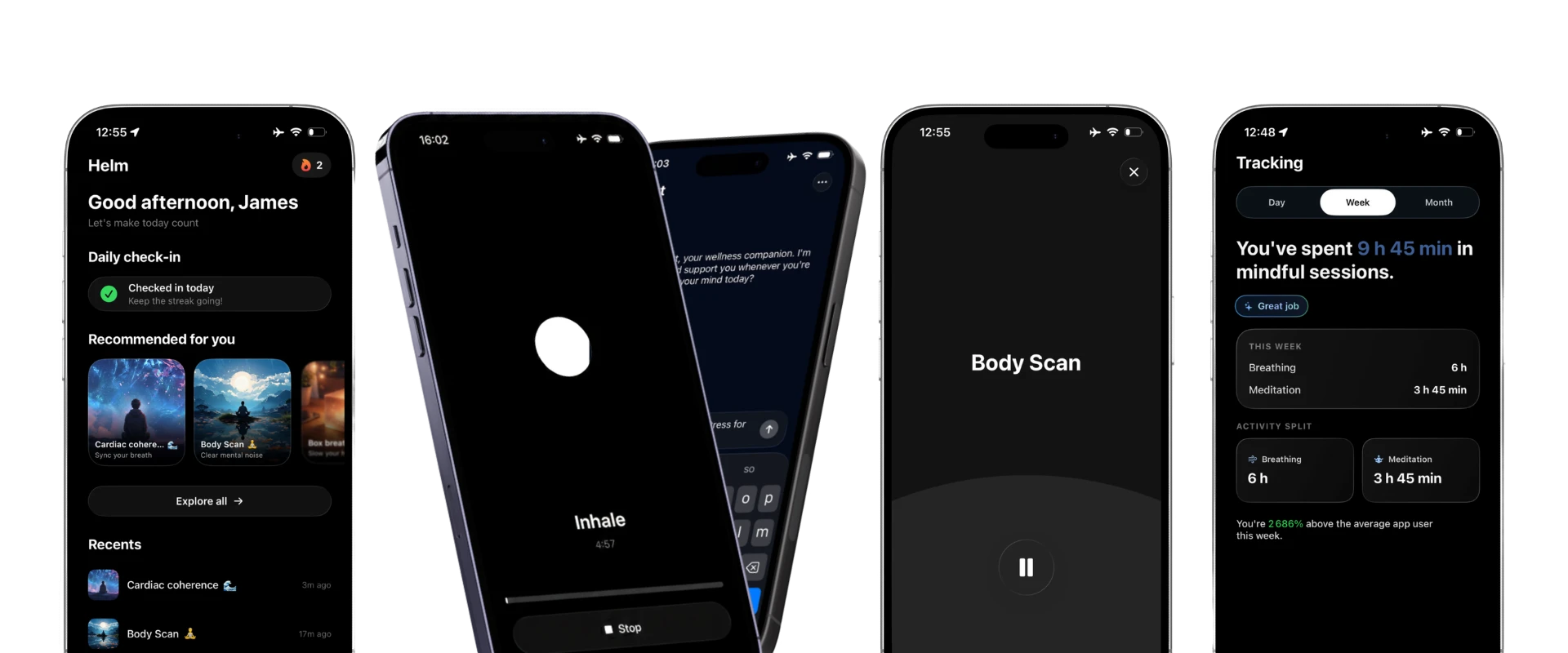
If you want guided breathing resets on your phone, try Helm, an iOS mental wellness app designed to manage stress and improve focus through guided breathing resets.
Use a light nasal inhale for 3 to 4 seconds and a longer nasal exhale for 6 to 8 seconds for 2 to 5 minutes. Keep it quiet and effortless.
Aim for 5 minutes once or twice daily for two weeks, plus brief 60 to 90 second resets when stress rises. Regular practice builds faster physiological recovery.
Yes, if you over-breathe, force big inhales, or add long breath holds. If you feel dizzy or panicky, reduce intensity, shorten counts, and return to normal breathing.
For many people, yes. Nasal breathing tends to slow airflow and reduce over-breathing, which supports more stable chemistry and calmer sensations.
Start with just one change: soften the exhale and make it a little longer than the inhale. Even small shifts can reduce escalation and create enough space to continue.
Join thousands using Helm to manage stress, improve focus, and build lasting healthy habits.