HELM
The Helm Blog
Insights on nervous system regulation, mental clarity, and the science of optimal performance.
HELM
HELM
HELM
HELM
HELM
HELM
Insights on nervous system regulation, mental clarity, and the science of optimal performance.
Helm is the #1 app to optimize your mind, breathe better, and master your focus. Combine science-backed breathwork and meditation into your daily protocol to build resilience.
Your heart and lungs are in constant conversation. When stress hits, that conversation gets choppy, and you feel it as racing thoughts and a body that cannot fully settle. Cardiac coherence benefits come from restoring a smoother rhythm between breathing, heart rate, and the nervous system, so your system can shift from bracing for danger to handling life with more ease.
This is not about forcing calm or trying to breathe perfectly. It is about training a predictable pattern that your body recognizes as safe: slow, steady breaths that create a more ordered heart rhythm pattern. With practice, you can use this as a portable reset before a meeting, after a hard conversation, or when you are trying to fall asleep.

Cardiac coherence describes a state where your heart rhythm pattern becomes more smooth and wave-like, often when you breathe at a slow, steady pace. In simple terms, your heart rate naturally speeds up a bit on the inhale and slows on the exhale. That normal variation is called heart rate variability (HRV), and coherence is what HRV can look like when your system is well coordinated.
This idea is closely related to respiratory sinus arrhythmia and to HRV biofeedback approaches used in clinics and research. A common target is around five to six breaths per minute, which tends to amplify the natural heart-breath coupling in many people. Research reviews on HRV biofeedback describe how paced breathing can influence autonomic function and stress responses (see a PubMed overview: https://pubmed.ncbi.nlm.nih.gov/20347618/).
It is important to keep expectations realistic. Coherence is not a magical frequency that fixes everything, and your “best” breathing rate can vary by body size, fitness, and anxiety level. The goal is a breath that feels steady, comfortable, and repeatable, not a number you force.
Stress is not only a thought problem, it is also a physiology problem. When your body perceives threat, your sympathetic nervous system increases arousal: heart rate rises, breathing gets shallow, and attention narrows. Coherent breathing patterns tend to increase parasympathetic influence through the vagus nerve, supporting autonomic balance and a more flexible stress response.
Mechanistically, slow breathing changes carbon dioxide tolerance, baroreflex activity, and the timing of signals between brain and body. Over time, this can improve your ability to come down from activation without needing perfect conditions. If you want a broader toolkit for acute moments, pair coherence practice with the strategies in fast ways to calm your nervous system when stress spikes, then use coherence as the training baseline.
You do not need to “empty your mind” for this to work. Your attention can rest on the sensation of air at the nostrils, the rise of the ribs, or a simple count. The benefit comes from repetition: your body learns a recognizable downshift cue, and the mind often follows.
For a credible medical perspective on the vagus nerve and how breathing can influence it, Cleveland Clinic provides a clear overview of vagal function and regulation: https://my.clevelandclinic.org/health/body/22279-vagus-nerve.
Most people first notice cardiac coherence benefits as a shift in “reactivity,” not as constant bliss. You still get stressed, but your system recovers faster. With consistent practice, common outcomes include steadier focus and fewer stress aftershocks.
Here are the benefits that show up most often in real life, especially when you practice for a few minutes per day:
These effects align with what many clinical resources note about slow breathing: it can lower arousal and support calmer physiology. Harvard Health summarizes how relaxation practices including breath regulation can reduce stress responses and improve well-being: https://www.health.harvard.edu/mind-and-mood/relaxation-techniques-breath-control-helps-quell-errant-stress-response.
One nuance: HRV is influenced by sleep, illness, alcohol, menstrual cycle, training load, and medications. If your HRV is “lower” one day, it does not mean coherence failed. Think of coherence as training coordination, not chasing a score.
The simplest entry point is a gentle, even breath with a slightly longer exhale. You are building consistency, so keep it easy enough that you could do it on a stressful day. If you are curious about the underlying physiology and why slow breathing works quickly, read the science behind breathing exercises to connect the dots without overcomplicating the practice.
Try this 5-minute routine:
A few common pitfalls can block progress even when you are “doing it right.” The biggest is trying too hard. Straining for deep breaths can cause lightheadedness and increase anxiety. Another is breath holding between inhale and exhale, which can spike arousal for some people. Aim for continuous airflow and comfort.
If you have asthma, COPD, panic disorder with strong fear of bodily sensations, or a cardiac condition, go slower and consult a clinician if you are unsure. Also be cautious if you feel tingling, dizziness, or air hunger, these are signs you may be over-breathing. The American Heart Association discusses HRV as a marker related to autonomic regulation and overall cardiovascular context, which is a helpful reminder that breathwork is supportive, not a substitute for medical care: https://www.heart.org/en/health-topics/arrhythmia/prevention--treatment-of-arrhythmia/heart-rate-variability.
To make coherence a habit, connect it to an existing cue. Do two minutes after brushing your teeth, before opening email, or right after you park your car. Small, frequent sessions build nervous system flexibility more reliably than rare long sessions.
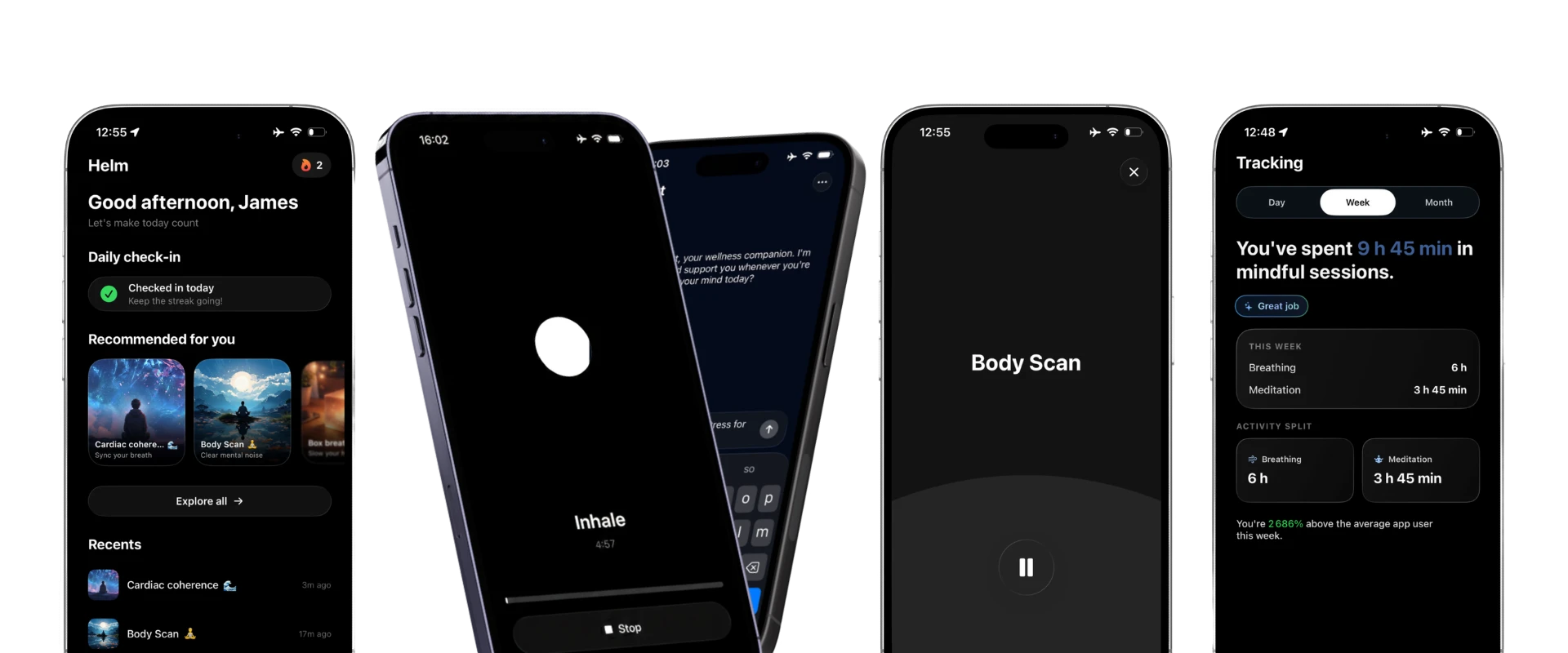
Cardiac coherence is a practical way to coordinate breath, heart rhythm patterns, and the nervous system so you can respond rather than react. The most reliable cardiac coherence benefits come from short, consistent practice that feels comfortable and sustainable, not from forcing intensity. Start with five minutes of smooth, quiet breathing, then use it as a bridge into the moments that usually hijack you, like transitions, conflict, or bedtime. Over time, you are training your body to recognize a calmer pattern as familiar, which makes steadiness easier to access when you need it most. If you want guided breathing resets on your phone, try Helm, an iOS mental wellness app designed to manage stress and improve focus through guided breathing resets.
Many people notice a shift in arousal within 1 to 5 minutes, but lasting changes in stress resilience usually take daily practice for 2 to 4 weeks.
A common starting point is about 5 to 6 breaths per minute, but comfort matters most. If you feel air hunger or dizziness, slow the depth and find an easier pace.
No. Box breathing uses equal holds and edges that can feel activating, while coherence practice typically uses smooth, continuous breathing to support a steadier autonomic response.
Yes, especially as a pre-sleep wind-down. A few minutes of slow nasal breathing can lower arousal and make it easier to transition from mental activity into rest.
Slow breathing can temporarily reduce stress-related spikes for some people, but results vary. Treat it as supportive regulation, not a replacement for medical evaluation or treatment.
Join thousands using Helm to manage stress, improve focus, and build lasting healthy habits.